
How to specify powder coated aluminum: define RAL color to a delta-E limit, write film thickness as a range, and understand why MOQ is really about color changeover.
Color is the part of a powder coating order that everyone agrees on in the meeting and argues about eight weeks later. "RAL 7016, matte" is not a specification — it is a starting point. Three things decide whether the parts that arrive match the sample on your desk: how the color is defined, how thick the film is allowed to be, and how much of one color the line can run without a changeover penalty.
This note covers those three, in the order they cause problems. Where the work actually happens — pretreatment, booth, cure — is on our powder coated aluminum line page.
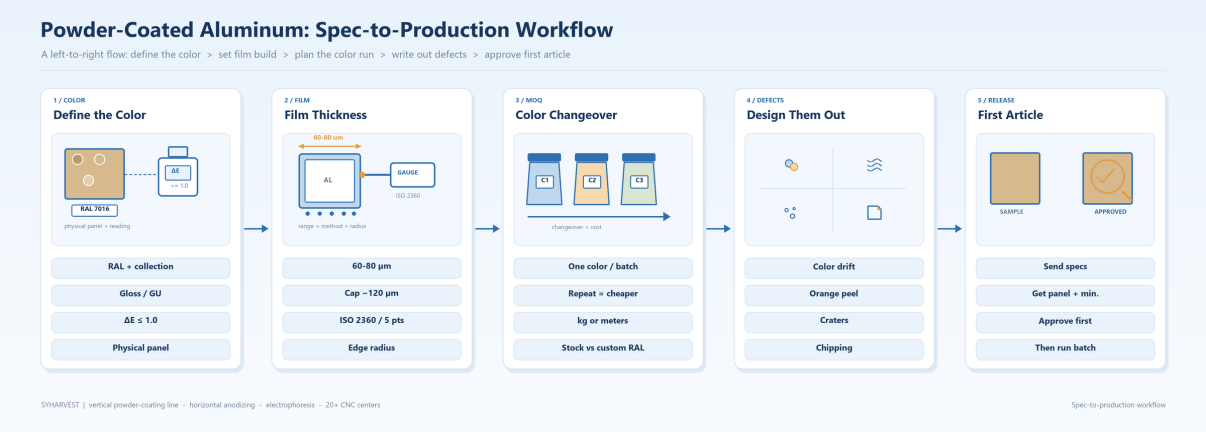
The five decisions that decide whether the delivered parts match your sample — in the order they go wrong.
1. Define the color, not the name
RAL is a color collection, not a paint. The same RAL number exists as a powder, a wet paint and an anodized dye, and they will not match each other. RAL 7016 in an architectural polyester powder is not the same reading as RAL 7016 in a wet two-pack.
What to write on the drawing:
| What to specify | Why it matters |
|---|---|
| RAL number and collection (RAL Classic / RAL Design / RAL Effect) | RAL 7016 Classic and a Design equivalent are different colors |
| Gloss level (GU range at stated angle + method + tolerance) | Gloss changes the perceived color more than 1–2 ΔE does |
| Substrate and pretreatment | Powder over chromated aluminum reads differently from powder over bare extrusion |
| Acceptance tolerance | ΔE ≤ 1.0 is a normal commercial target; ΔE ≤ 0.5 needs a colorimeter on both sides |
| Sample approval route | Physical panel approved by you, retained by us, referenced on the PO |
Two practical notes from the line:
- Send a physical sample when the color is critical. A PDF of a RAL card plus a screen is not a color reference. If the part is visible on the finished product, approve a sprayed aluminum panel, not a paper swatch.
- Metallics and textured finishes cannot be judged by ΔE alone. For silver metallic or sand-texture, agree on a photo under defined lighting plus a physical panel; instrument readings will disagree with the eye.
2. Film thickness is a range, not a target
Architectural powder is typically specified between 60 and 80 microns. Decorative interior parts are often run thinner, around 40 to 60 microns. Anything above roughly 120 microns starts to bring its own problems: orange peel, cracking at bend radii, and masking removal that tears the edge.
Write the requirement as a range with a measuring method:
- Range, e.g. 60–80 µm, not "min 60".
- Where measured, e.g. on the flat face of the profile, away from corners and 10 mm in from the ends.
- Method, e.g. eddy-current gauge per ISO 2360, five readings per part, average and minimum both reported. (ISO 2178 is the magnetic-induction method and applies to coatings on steel, not on aluminium — aluminium is non-magnetic, so the eddy-current route is the correct one here.)
- Corners and edges: powder pulls back from sharp edges. If the edge is a wear point, say so — it needs a radius, not more powder.
Film thickness also interacts with tolerance. A 70 µm coating adds 0.07 mm per surface. On a sliding fit or a thread, that matters. Mask threads, bores and mating faces and say so on the drawing — masking is a manual step and suppliers quote it differently.
3. MOQ is really about color changeover
This is the number that surprises first-time buyers most. A powder line does not price only the parts; it prices the color run. Changing from one color to another means cleaning the booth, the gun path and the recovery system. That changeover cost is spread across however many parts run in that color.
Practical consequences:
- One color, one batch. If your project needs three colors, expect three minimum quantities and three changeovers, even for the same profile.
- Repeats are cheaper than first runs. A repeat order in a color we already hold reads lower than a new color, because the powder is on the shelf and the line settings are proven.
- Small quantities of a special color can be a poor trade-off, especially where the special-color powder MOQ exceeds the extrusion lot. If you need 50 pieces in a custom RAL, ask for the price both in the special color and in the nearest stock RAL — the difference is often larger than the value of the exact shade.
- Ask for the minimum in kilos of powder or in meters of profile, not "MOQ: 1 set". A number you cannot check is not a number.
For extrusion + coating orders, the minimum is usually driven by the extrusion lot, not the coating: you have to run a billet batch anyway, so the color minimum rarely sits above it.
The four defects to write out of the order
| Defect | Usual cause | Prevention written into the spec |
|---|---|---|
| Color drift between batches | Different powder lot, different film thickness | One lot number per batch; thickness range fixed; retain a coupon per lot |
| Orange peel | Film too thick, gun distance, cure too fast | Max thickness cap; cure schedule per powder datasheet |
| Craters / pinholes | Contamination in pretreatment or air line | Pretreatment sequence stated; no silicone in the area |
| Chipping on assembly | Insufficient film at edges, no radius | Edge radius callout; min thickness measured at edges too |
What we run
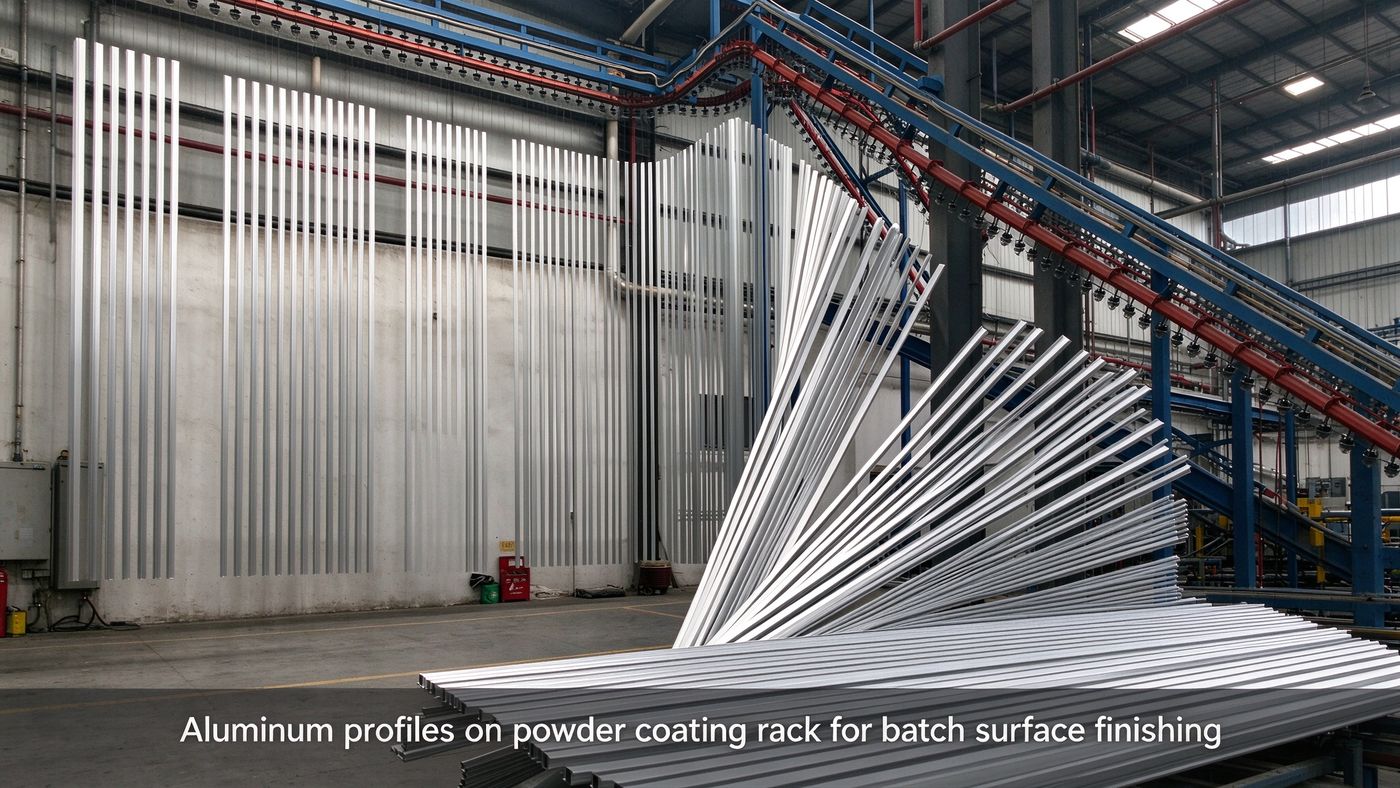
Racked and ready: on a vertical line the parts hang and drain evenly, which is why long profiles coat better upright — and why the bottom end has to be checked on the first article.
SYHARVEST finishes extruded profiles on a vertical powder coating line with a horizontal anodizing line and electrophoresis as an option, alongside machining on 20+ CNC centers. Vertical lines are good for long profiles because the part hangs and drains evenly — the trade-off is that long parts swing, so rack marks and film variation at the bottom end need to be checked on the first article.
If you are specifying a coated profile, send the RAL reference, the gloss level, the thickness range and the volumes per color. We will come back with a per-color minimum and a first-article panel before the batch runs, so the argument about color happens once, before the parts exist.
Two related notes: why aluminum profile lead times slip covers where coating sits in the schedule, and the powder coating capability page lists the line and pretreatment sequence.
Interested in Our Products?
Contact us today for a professional quotation tailored to your requirements.
Get a Free Quote