
Two extruders can quote the same drawing at prices that look unrelated without either one cheating. Here are the eight cost lines that actually move an aluminum extrusion price — metal and scrap, alloy and temper, profile geometry, die amortization, tolerance class, surface finish, machining, and order size — plus the eight questions to ask so you can compare quotes line by line.
Two extruders can quote the same drawing at prices that look unrelated, and often neither shop is cheating. The gap is decided before the quote is typed: which press the profile runs on, how much metal leaves the press as scrap, how the die is amortized, and how much hand work sits between the press and the pallet.
The gap is not a pricing trick — it is eight cost lines you can check one by one.
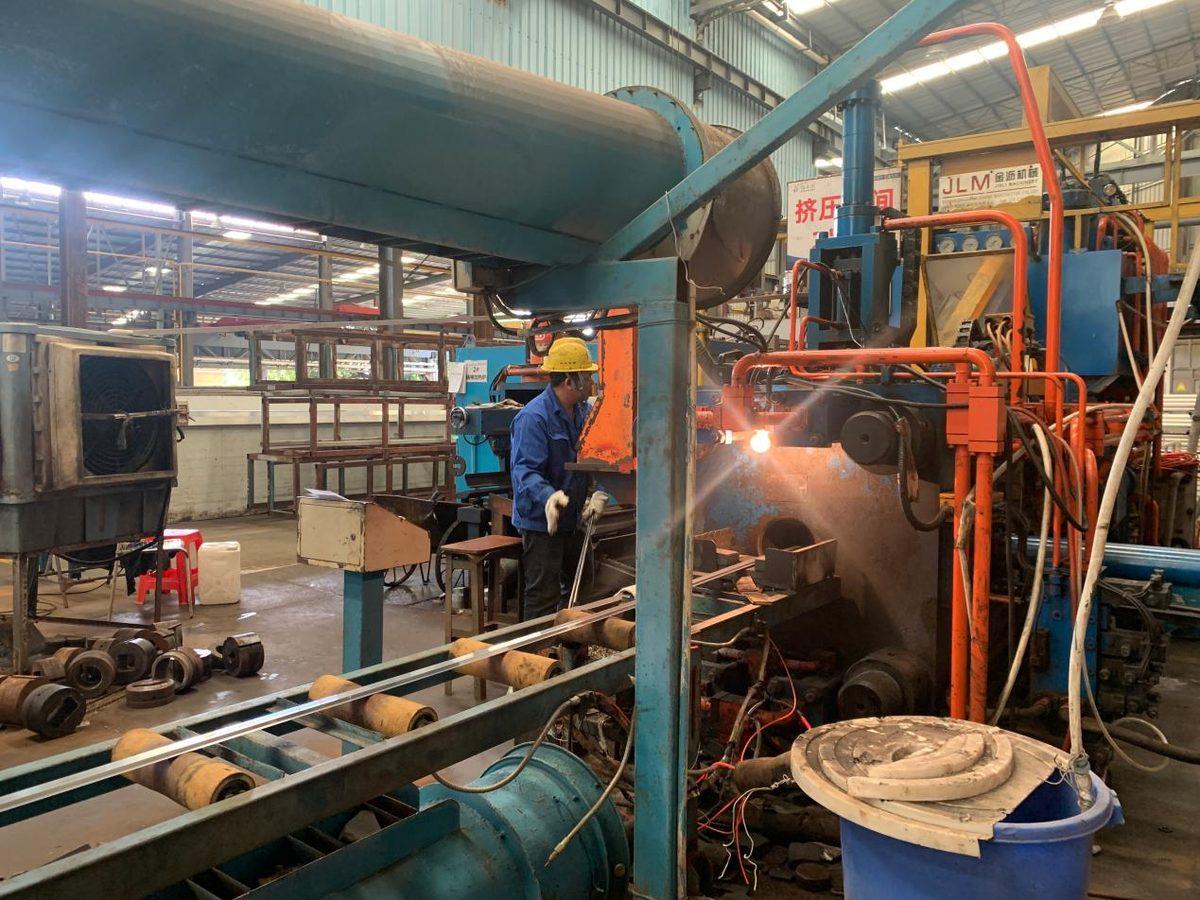
Billet to profile in a single stroke — the press a job runs on sets the metal price before any quote is typed.
The cost lines at a glance
| Cost line | What drives it | When it dominates |
|---|---|---|
| Metal | Alloy, billet diameter, scrap rate | Always — the largest line in any quote |
| Alloy and temper | 6063 vs 6061 vs 6005, T5 vs T6 | Strength or machining requirements |
| Profile geometry | Wall thickness, tongue ratio, circumscribed circle | Thin walls, wide circles, hollow sections |
| Die | Cavities, hollow vs solid, expected life | Small orders; multi-cavity dies |
| Tolerance class | Standard vs precision, straightness, cut length | Visible or mating surfaces |
| Surface finish | Anodizing, powder coating, electrophoresis | Architectural and consumer parts |
| Machining and assembly | Operations, fixtures, deburring, inserts | Finished parts, not mill lengths |
| Order size and packing | MOQ, cut lengths, crates, freight terms | Small or mixed orders |
1. Metal: the largest line, and it is three numbers
The first is the LME aluminum price. It moves daily, which is why a quote carries a validity date and a metal clause on long-running orders.
The second is the conversion premium — the charge for turning primary metal into homogenized billet of the right alloy and diameter. It differs by alloy, and it is where 6061 and 6005 sit above 6063.
The third is scrap. Every meter carries butt ends, run-out, cut-off and rejects. A thin-walled profile on a large circumscribed circle produces far more scrap per good meter than a compact tube. The scrap goes back to the furnace, but you pay the conversion cost on it twice.
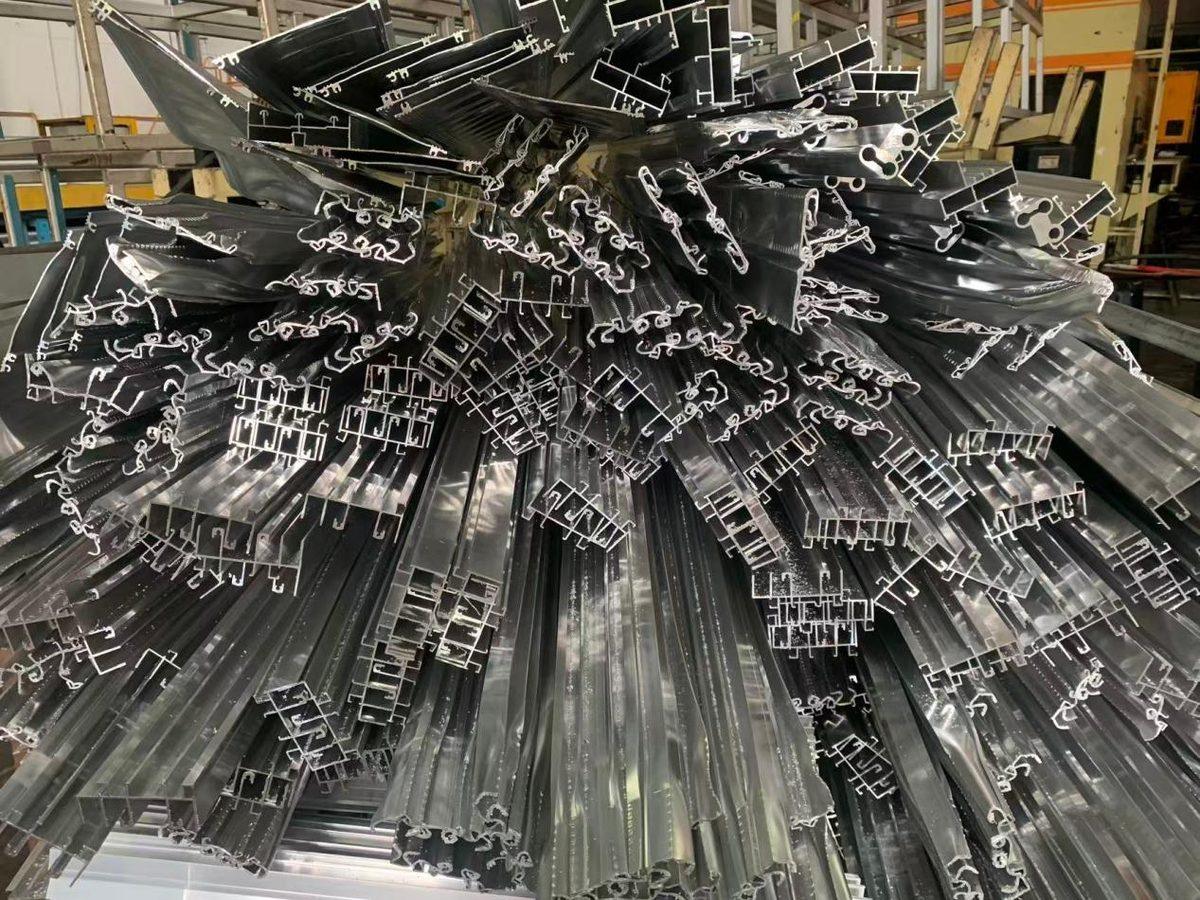
Butt ends, run-out and cut-off: every kilogram of scrap is paid for twice — once as metal, once as conversion.
Billet diameter matters too: we run 90 mm to 254 mm. The right choice is the smallest billet that fills the container, because an oversized billet means more discard on every stroke.
2. Alloy and temper
6063 is the default: it extrudes fast, anodizes well and holds tolerance on thin walls. 6061 is stronger but slower — higher pressure, lower ram speed, shorter die life — and the price reflects it. 6005 sits between the two and suits structural parts.
Temper matters as much. T5 is press-quenched and aged; T6 adds solution heat treatment and aging, buying strength at the cost of an extra step and more straightening. If the part is only a decorative cover, 6061-T6 is strength you will never use.
3. Profile geometry
Four geometric facts decide how easily a profile extrudes:
- Wall thickness. Below roughly 1.2 mm, die wear, breakage risk and scrap all climb.
- Tongue ratio. In a hollow die, tongue length against tongue width governs how fast the press can run without the tongue breaking.
- Circumscribed circle. Our largest press handles up to 320 mm circumscribed circle; quoting a part on a 2,500-ton press when a 660-ton press would do costs more for no gain.
- Cavities. More cavities per die mean more output per stroke, but a more expensive die and tighter metal flow balance.
4. Die cost and how it amortizes
The die is a one-off, and that single fact explains most of the price difference between a trial order and a production run.
A solid die is cheaper than a hollow die with portholes. A single-cavity die is cheaper than a four-cavity die, though the four-cavity version may halve press time per kilogram. Nitriding extends die life: fewer stops, fewer corrections, less scrap per ton.
Read a die charge per kilogram of the order, spread across your annual volume.
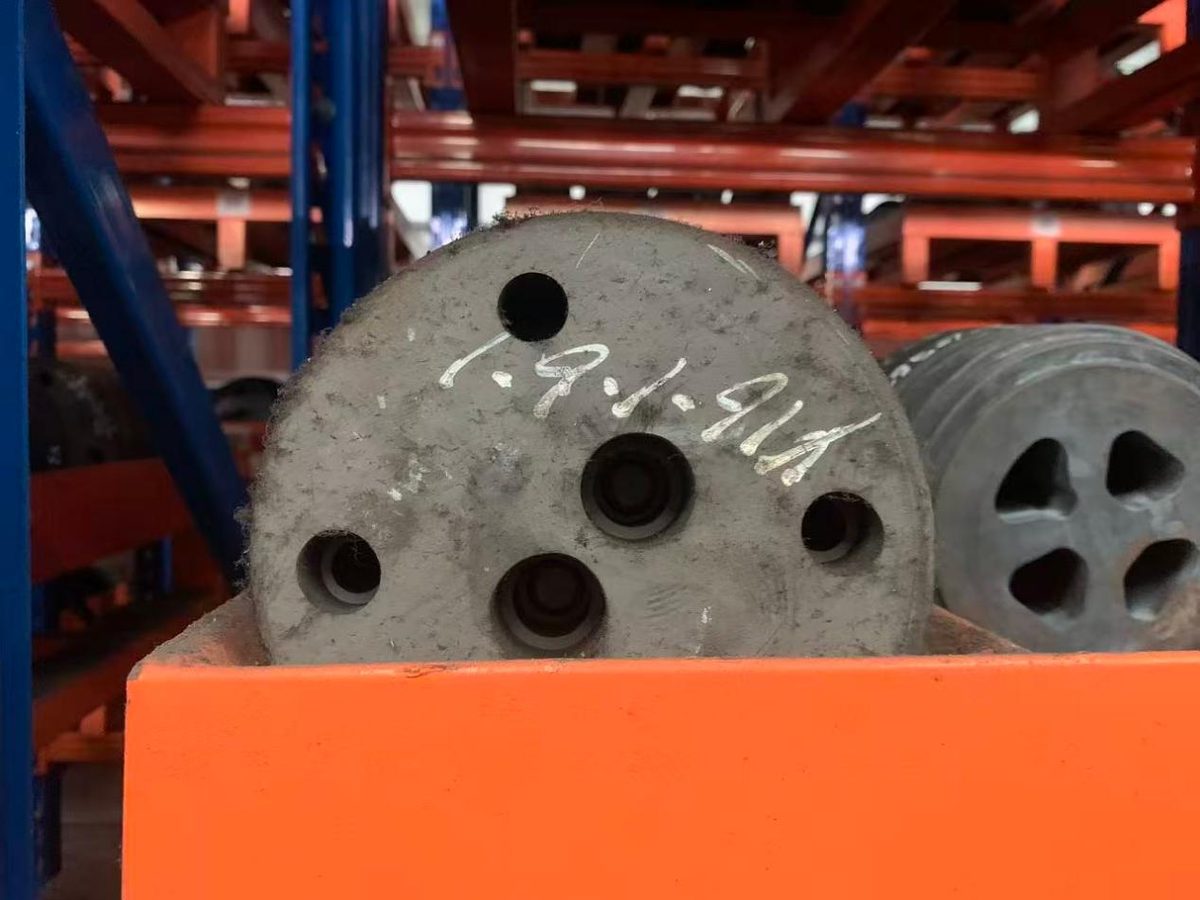
Porthole dies on the rack — port count and die life both land in the per-kilogram rate.
5. Tolerance class
Precision tolerance does not change the metal; it changes how the line runs and how much output is inspected, straightened or rejected. Cut length shows it: a ±0.5 mm saw cut on mill lengths is routine, a ±0.1 mm cut on 2,000 pieces is a different operation with its own fixture and rejection rate.
6. Surface finish
Anodizing and powder coating are priced by square meter, not by kilogram.
For anodizing, film thickness is the main lever: 10, 15, 20 and 25 µm are different residence times in the same line. Color adds steps — clear is the baseline, black dye and electrolytic bronze more. Whether profiles are anodized in full length then cut, or cut first, changes both cost and the look of the cut ends.
Powder coating depends on pretreatment, film build, color and racking density — how many pieces hang per square meter of line sets the price per piece.
We run anodizing, a vertical powder coating line and electrophoresis in-house. All three under one roof means no extra transport leg or handling cycle, and one party responsible for a scratch or color mismatch.
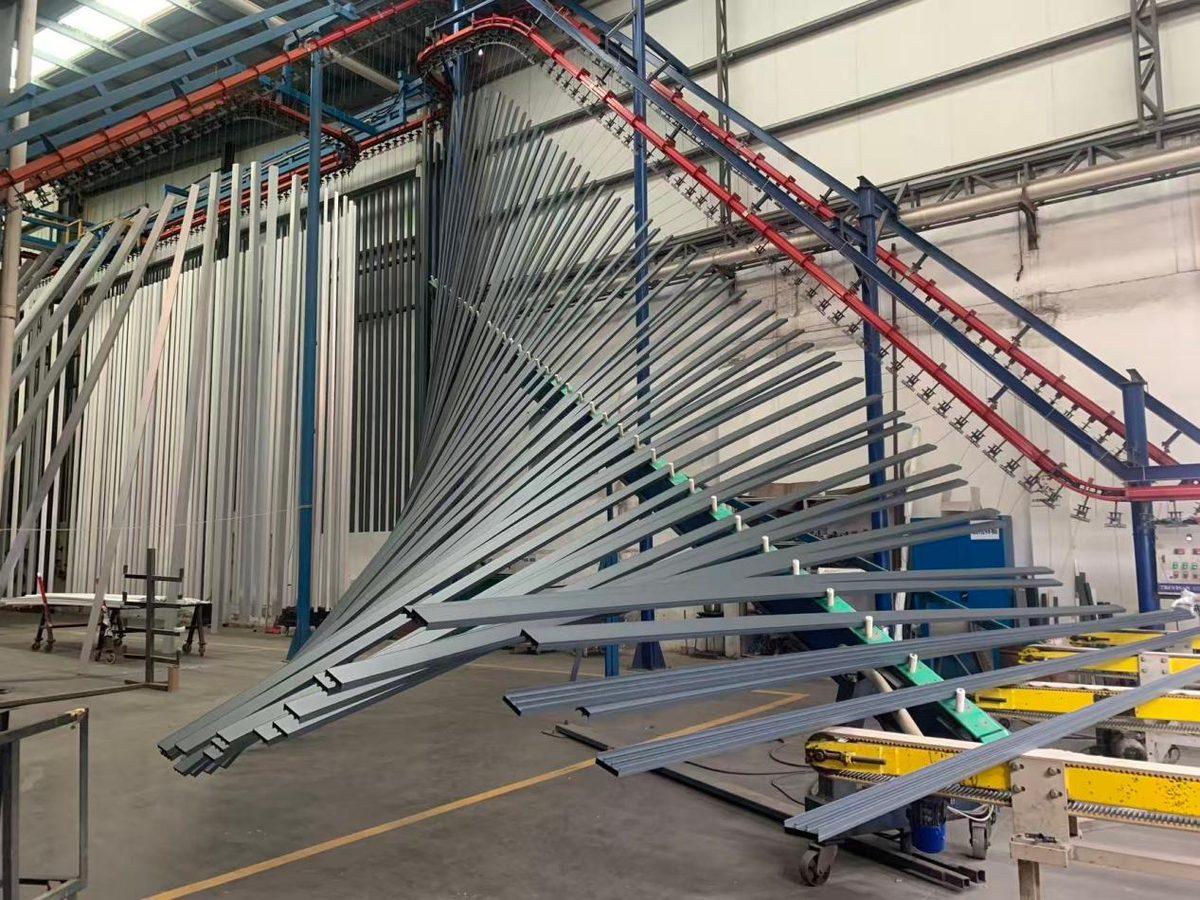
Racking density on the vertical powder coating line sets the price per piece, not just the price per square meter.
7. Machining and assembly
Past the press, cost switches from kilograms to operations: every cut, punch, mill, drill and tap has a cycle time, a fixture and a setup charge. Deburring and cleaning are manual on most parts and scale with labour, not metal. This is where in-house CNC earns its keep — a dimensional issue is caught before anodizing, not after the parts cross an ocean.
8. Order size, packing and freight
Minimum order quantity is set per profile, per finish and per color: each combination needs a die, a press run and rack space. Mixed pallets, short cut lengths and bagging add handling; a crate that survives a sea voyage costs more than stretch film, and far less than a claim.
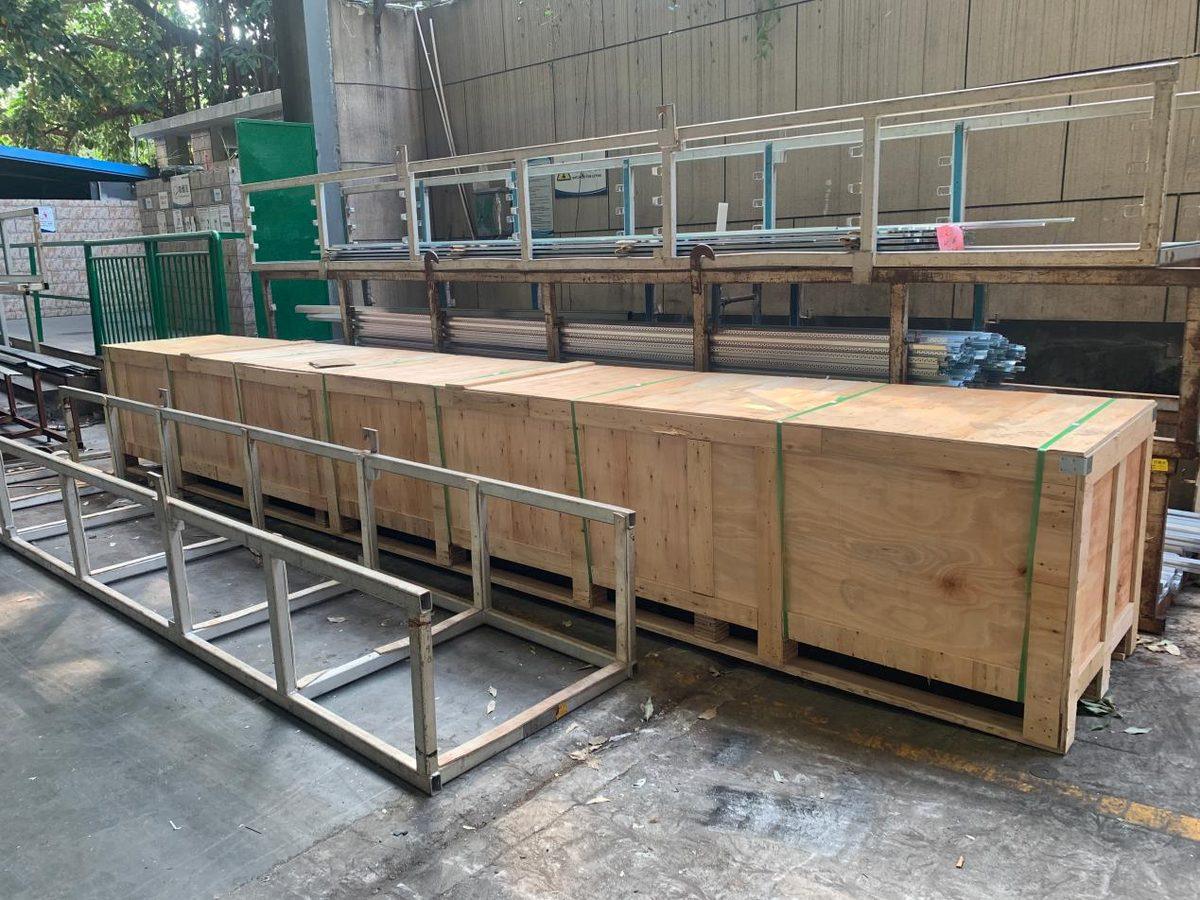
Crated, strapped and lined up for loading — packing that survives a sea voyage costs more than stretch film, and far less than a claim.
How to compare two quotes properly
Ask both suppliers the same eight questions:
- What is the metal price and the conversion charge, separately?
- What scrap allowance is built into the per-kilogram rate?
- How many cavities does the die have, and what is the die charge?
- Which press will run this profile, and at what tonnage?
- Which tolerance class are you quoting to?
- What film thickness and pretreatment are included?
- Are machining operations quoted per piece or per hour?
- What is the MOQ per finish and color?
The lowest kilogram rate often loses once die amortization, scrap allowance and reject rate are put back in.
What we need to quote accurately
Send a 2D drawing with alloy, temper, tolerance class, surface specification, cut lengths and annual volume, and we will return a costed breakdown — billet, extrusion, die, finish and machining shown separately.
Our presses run 660 to 4,000 tons, billets from 90 mm to 254 mm, in 6063, 6061 and 6005, with anodizing, powder coating, electrophoresis and CNC all in-house. Lead time is 5–7 days for mill finish, around 12 days with surface treatment, 15–18 days with machining.
Send your drawing through our quote page at https://www.syharvest.com/quote.html and you will get a reply within 24 hours, with the pricing assumptions shown so you can check them.
Interested in Our Products?
Contact us today for a professional quotation tailored to your requirements.
Get a Free Quote